
Be There
Blog
10 Essential Event Survey Questions for Meaningful Feedback
By BeThere
Nov 25, 2025 • 28 min read
Share this post


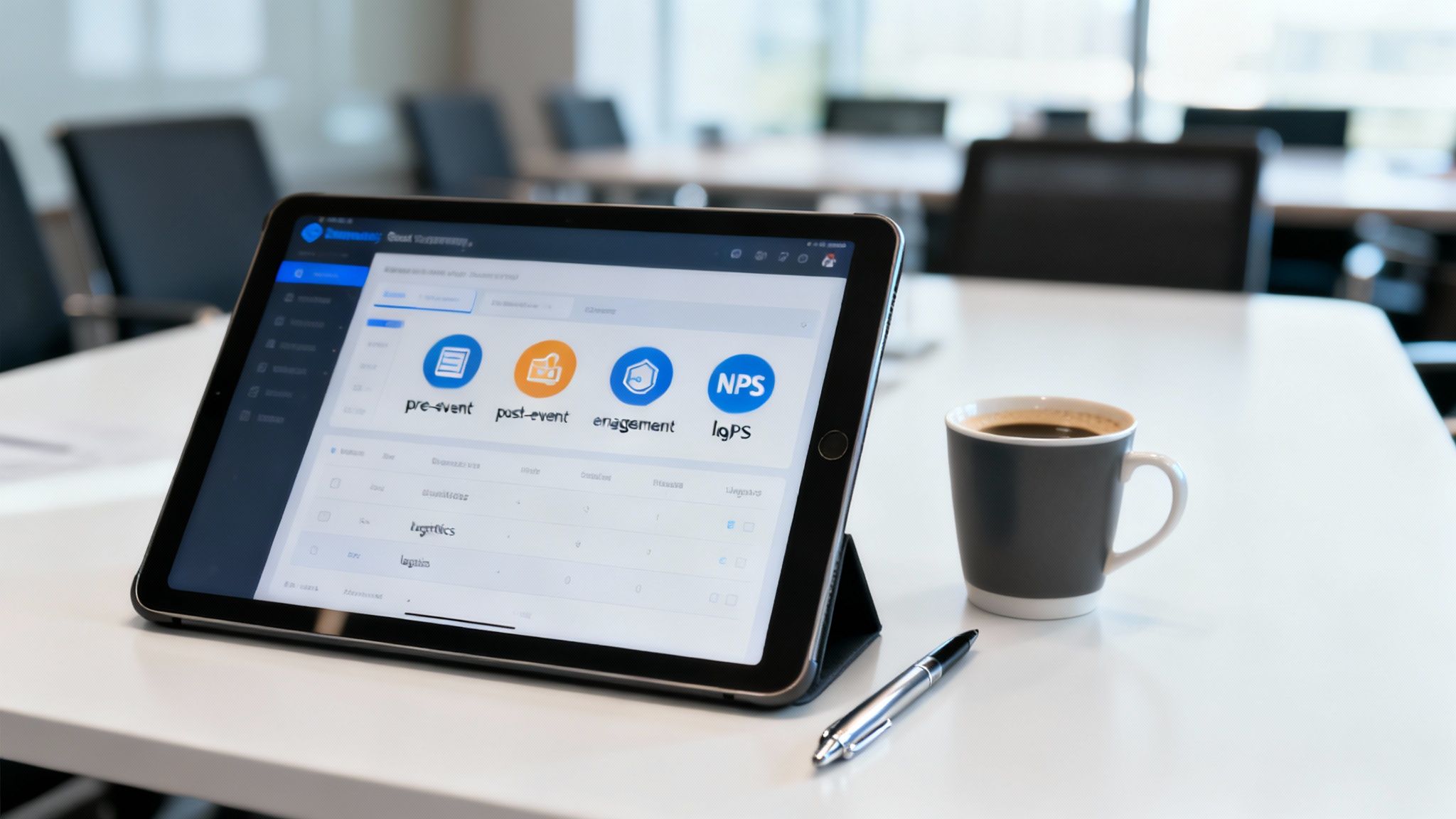
Planning a successful event is a massive undertaking, but the real work begins once the curtains close. Understanding its impact, what resonated with attendees, and where you can improve is what separates a one-off gathering from a must-attend experience. The secret to unlocking this crucial data lies in asking the right event survey questions. This isn't just about collecting feedback; it's about gathering actionable intelligence to prove ROI, enhance future events, and strengthen your relationship with your audience.
This guide provides a comprehensive list of the most effective event survey questions you can use today. We’ll move beyond generic inquiries to give you targeted, ready-to-use templates for every stage of your event lifecycle, from pre-event planning to post-event analysis. You'll find specific questions for measuring overall satisfaction, speaker performance, logistical efficiency, and attendee engagement. We will cover how to ask, when to ask, and what to do with the answers.
For companies who use both Slack and Google Calendar internally, gathering this feedback can be incredibly efficient. A tool like Be There (https://be-there.co) is especially handy, as it integrates directly with your Slack workspace and Google Calendar, allowing you to send quick polls and surveys right where your team is already communicating. This approach simplifies the feedback process, boosting response rates and turning data collection into a seamless part of your workflow. To truly unlock actionable insights and make your event feedback dynamic, learn how to create video surveys that capture direct participant engagement. Let's dive into the questions that will transform your event strategy.
1. Overall Event Satisfaction Rating
This is the cornerstone of nearly every post-event survey. An overall satisfaction question asks attendees to rate their experience on a simple numerical scale, typically 1 to 5 or 1 to 10. It serves as a high-level key performance indicator (KPI), giving you a quick, quantifiable measure of event success before you dive into more specific feedback.
This metric's power lies in its simplicity. For a tech conference, a virtual all-hands meeting, or an in-person trade show, this single number provides an immediate signal of whether you hit the mark. It’s an essential first question in your post-event survey because it captures the attendee's immediate, top-of-mind sentiment.
✦Why It's an Essential Event Survey Question
The overall satisfaction score is your primary benchmark. It helps you track performance over time, compare different events, and quickly identify if a particular event format or theme resonated better than another. A high score validates your efforts, while a low score is an immediate red flag that a deeper analysis is needed. This question acts as a gateway; a low rating from a respondent primes them to explain why in subsequent open-ended questions.
Pro Tip: Use a consistent scale across all your events (e.g., always use a 1-10 scale). This allows you to create a historical baseline and accurately compare a virtual workshop to an annual in-person summit, providing a clearer picture of your overall event program performance.
✦Implementation and Best Practices
- Placement: Always place this question at the very beginning of your survey to capture an unbiased, initial gut reaction.
- Timing: For the most accurate feedback, send the survey immediately after the event concludes. The experience is still fresh in the attendee's mind.
- Follow-Up: Pair this quantitative question with a qualitative follow-up, such as "What was the primary reason for the score you gave?" This uncovers the context behind the number.
For companies that use both Slack and Google Calendar, a tool like Be There (https://be-there.co) is very useful for automating this process seamlessly. You can schedule a post-event satisfaction poll to be sent directly to the event’s Slack channel a few minutes after the Google Calendar event ends, ensuring you capture feedback while engagement is highest. This is particularly effective for internal events where high response rates are crucial, similar to how one might approach gathering feedback with employee engagement survey questions.
2. Session/Speaker Quality Rating
For events centered on content, such as conferences, workshops, or training sessions, the quality of individual sessions and speakers is paramount. This question drills down past the overall event impression to evaluate the effectiveness of specific content segments. It asks attendees to rate elements like speaker knowledge, presentation clarity, and content relevance, providing granular feedback on the core value proposition of your event.
This detailed insight is crucial for planning future content. Whether it's a corporate training seminar evaluating an instructor's impact or a multi-track tech conference assessing which topics resonated most, this feedback is your guide. It helps you understand which speakers to invite back, what presentation styles work best, and which subjects your audience is eager to learn more about.
✦Why It's an Essential Event Survey Question
Session-specific feedback is the most direct way to measure your event's content ROI. It helps you identify your strongest performers (both speakers and topics) and pinpoint areas needing improvement. This data is invaluable for content curation, ensuring that your next event’s agenda is even more compelling and aligned with attendee expectations. By comparing ratings, you can build a roster of proven, high-impact speakers and refine your content strategy with confidence.
Pro Tip: If your event has multiple sessions, ask this question for each one the attendee went to. While it extends the survey, the specific, actionable data you get on every single content piece is far more valuable than a generalized opinion.
✦Implementation and Best practices
- Placement: Ask these questions immediately after the overall satisfaction rating, while the specific details of sessions are still fresh.
- Timing: For multi-session events, the best approach is to poll attendees right after each session concludes. This captures immediate, in-the-moment reactions.
- Follow-Up: Accompany the rating scale with an open-ended question like, "What did you like most about this session?" or "How could this presentation be improved?" to gather qualitative insights.
For companies that rely on Slack and Google Calendar, this process can be automated with tools like Be There (https://be-there.co), which is extremely handy for real-time feedback. You can set up polls to be sent to specific session channels (e.g., #track-a-marketing) just as a speaker finishes their talk. This real-time feedback loop is a powerful way to gauge engagement and gather precise data without waiting for a post-event summary, making it one of the most effective event survey questions for content-driven gatherings.
3. Networking Opportunities Assessment
For many attendees, the true value of an event lies in the connections they make. A networking opportunities assessment evaluates how well your event facilitated these crucial interactions. These questions go beyond session content to measure whether attendees had meaningful opportunities to connect with peers, industry leaders, or potential business partners, making them essential for conferences, trade shows, and professional association meetings.
This assessment helps you understand if your networking strategy-from designated lounges to structured icebreakers-was effective. For a B2B conference, this could translate to lead generation success. For an alumni reunion, it measures the strength of community bonds. Gauging this aspect is critical because positive networking experiences are a powerful driver of repeat attendance and positive word-of-mouth.

✦Why It's an Essential Event Survey Question
Networking is often a primary motivator for attendance. By asking specific event survey questions about this experience, you can directly measure your ROI for a significant portion of your audience. Feedback on networking helps you pinpoint what works, whether it's a new matchmaking app or a simple, well-placed coffee station. It tells you if you provided the right environment and tools for valuable connections to happen.
Strong networking opportunities build a loyal community around your event. Understanding what attendees valued, or found lacking, allows you to refine your approach for future events, ensuring you deliver a platform that fosters genuine relationship-building and not just passive content consumption.
Pro Tip: Ask attendees to rate both the quantity and quality of the connections they made. An attendee might have met 50 people but only had one meaningful conversation. Differentiating between the two provides a much more nuanced understanding of your event's networking success.
✦Implementation and Best Practices
- Be Specific: Ask about specific networking activities. For example, "How valuable was the 'Meet the Speakers' lunch?" is more insightful than "Did you like the networking?"
- Set Expectations: Frame a question like, "Did the networking opportunities meet, exceed, or fall short of your expectations?" This helps contextualize their satisfaction level.
- Measure Impact: Include a question that ties networking to future actions, such as "How likely are you to follow up with a connection you made at this event?"
For companies using both Slack and Google Calendar for internal events like team-building or cross-departmental mixers, measuring networking effectiveness is just as important. A tool like Be There (https://be-there.co) is very useful here, as it can automate this feedback loop. By scheduling a quick poll in the relevant Slack channel right after the Google Calendar event ends, you can ask targeted questions about how well employees connected, providing immediate data to improve future internal engagement initiatives.
4. Venue and Logistics Satisfaction
While content is king, the physical and operational environment can make or break an attendee’s experience. Venue and logistics satisfaction questions assess practical elements like the venue's quality, accessibility, signage, seating, and overall organization. This feedback is critical for understanding the tangible aspects of your event that directly impact comfort and convenience.
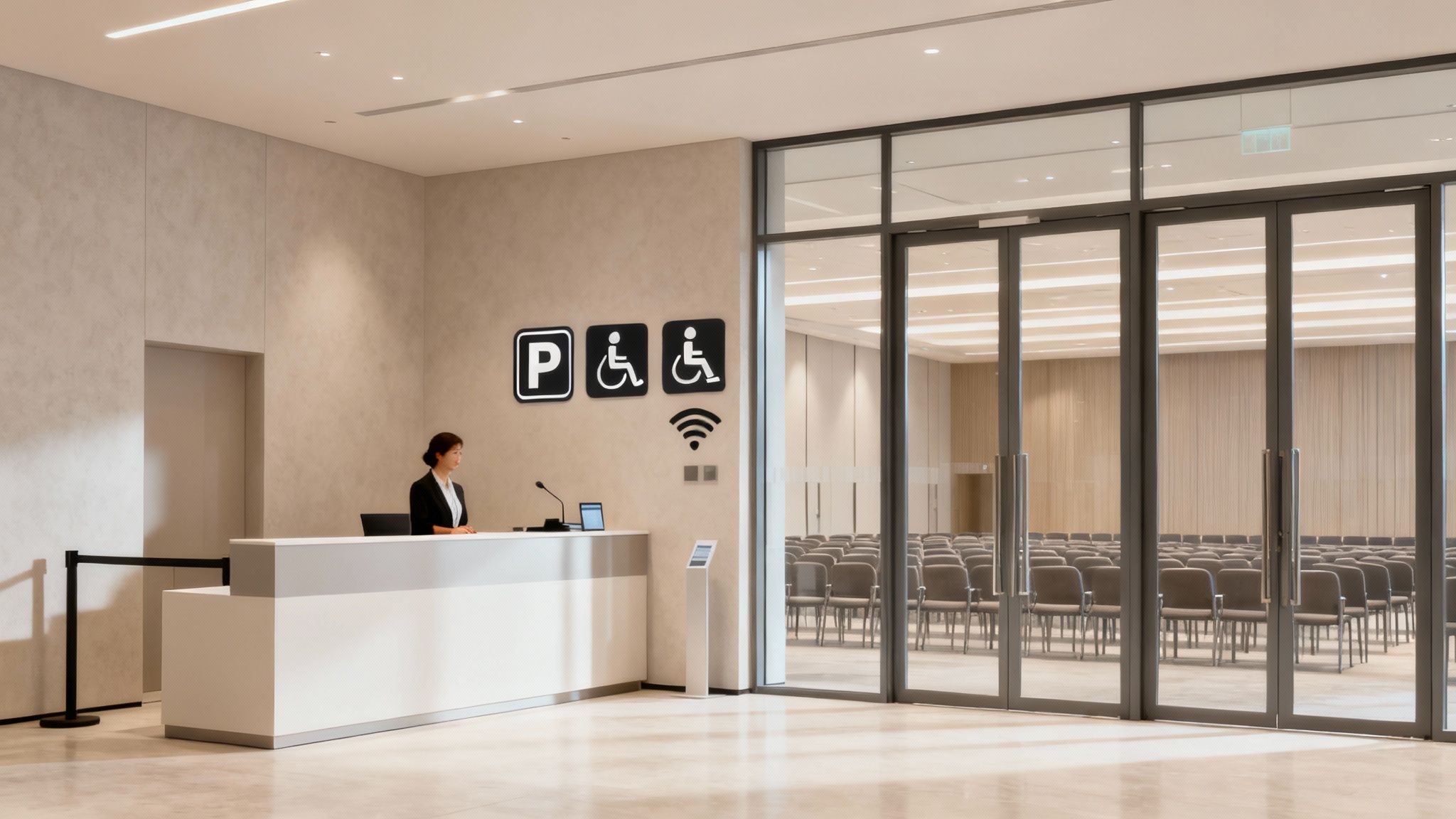
Whether it’s a hotel conference where Wi-Fi quality is paramount or an outdoor festival where parking and restroom facilities are a top concern, these questions uncover friction points. For virtual events, this translates to measuring platform usability and the availability of technical support. Neglecting these details can overshadow even the most compelling content.
✦Why It's an Essential Event Survey Question
Logistical feedback provides a clear, actionable roadmap for improvement. Uncovering issues like a confusing check-in process, uncomfortable room temperatures, or poor signage helps you refine your operational playbook for future events. This data is invaluable for vendor selection, budget allocation, and enhancing the overall attendee journey, forming a key part of your event planning and project management. A smooth, seamless experience demonstrates professionalism and respect for your attendees' time and comfort.
Pro Tip: For virtual and hybrid events, ask specifically about the digital "venue." Questions about platform navigation, audio/video quality, and the ease of accessing sessions can reveal critical technical pain points that hinder engagement and participation.
✦Implementation and Best Practices
- Be Specific: Instead of a single "Rate the venue" question, break it down. Ask about specific elements like parking, check-in efficiency, seating comfort, and Wi-Fi performance.
- Include Accessibility: Always include a question about accessibility. This shows inclusivity and provides crucial feedback on how well you accommodated attendees with disabilities.
- Segment Your Questions: Group related logistical questions together in their own section of the survey to create a logical flow for the respondent.
For internal company events managed through Google Calendar and Slack, logistical feedback is just as important. With a tool like Be There (https://be-there.co), you can trigger a quick poll in a dedicated Slack channel immediately after a town hall or workshop. This is a very handy feature for asking, "How was the audio and video quality during today's virtual meeting?" This allows for instant feedback collection, helping your IT and event teams address technical issues before the next session.
5. Likelihood to Recommend (NPS-Style Question)
Beyond simple satisfaction, the Net Promoter Score (NPS) style question measures attendee loyalty and enthusiasm. It asks a single, powerful question: “On a scale of 0-10, how likely are you to recommend this event to a friend or colleague?” This metric is a strong predictor of future growth, word-of-mouth marketing, and overall event advocacy.
This question segments your audience into three distinct categories: Promoters (score 9-10), Passives (score 7-8), and Detractors (score 0-6). For a large industry conference, a high NPS indicates a strong brand reputation. For an internal corporate training, it signals that employees found the session valuable enough to champion it among their peers, making it one of the most insightful event survey questions you can ask.
✦Why It's an Essential Event Survey Question
The NPS provides a standardized benchmark that is widely recognized across industries, making it easy to compare your event's performance against established standards. It moves beyond a simple "did you like it?" to "would you stake your reputation on it?" A high NPS score is a powerful indicator that your event is not just successful, but memorable and influential. Tracking this metric over time shows whether your event improvements are creating more loyal advocates.
Pro Tip: Don't just look at the overall score. Analyze the feedback from your Promoters to understand what you did right and replicate it. More importantly, dive deep into the feedback from Detractors to identify critical pain points that need immediate attention.
✦Implementation and Best Practices
- Placement: Position the NPS question after the initial overall satisfaction rating but before more granular questions about specific sessions or logistics.
- Wording: Keep the question consistent: "How likely are you to recommend [Event Name] to a colleague or friend?" The 0-10 scale is non-negotiable for a true NPS.
- Follow-Up: The most crucial part of NPS is the follow-up. Always ask, "What is the primary reason for your score?" This open-ended question provides the actionable insights behind the number.
For internal events like all-hands meetings, a tool like Be There (https://be-there.co) is extremely useful. Because it integrates with both Slack and Google Calendar, you can schedule an NPS poll to appear in the relevant Slack channel right after the event. This captures immediate sentiment and makes it incredibly easy for employees to respond, boosting participation and providing your team with a clear metric for event success.
6. Value for Time Investment
Beyond cost, an attendee's most valuable and finite resource is their time. This question moves past simple satisfaction to measure the perceived return on investment (ROI) from an attendee's perspective. It asks whether the content, networking, and learning opportunities justified the time they dedicated to being present, whether for a one-hour webinar or a multi-day conference.
This metric is especially critical for events aimed at busy professionals, like executive forums or professional development workshops. It acknowledges that attendees are making a trade-off, and their feedback on whether that trade was worthwhile is a powerful indicator of your event's true impact. A positive response means you delivered tangible value that respected their schedule.
✦Why It's an Essential Event Survey Question
The "value for time" question helps you quantify the efficiency and density of your event programming. If attendees felt their time was well-spent, it validates your agenda, pacing, and content quality. A low score, however, can indicate issues like session filler, poor scheduling, or a mismatch between the advertised value and the actual experience. This insight is crucial for optimizing future event schedules and ensuring every moment on the agenda serves a purpose.
Pro Tip: Segment responses by attendee role or seniority. A C-suite executive's perception of valuable time investment may differ significantly from that of a junior team member. This segmentation can help you tailor future event tracks and content to better meet the expectations of different audience groups.
✦Implementation and Best Practices
- Wording: Frame the question clearly. For example, "How would you rate the value you received for the time you invested in this event?" using a scale from "Poor value" to "Excellent value."
- Context: Ask this question after attendees have rated specific components like sessions and networking. This allows them to consider all elements of the event when making their assessment.
- Follow-Up: Pair it with a question like, "Which part of the event provided the most value for your time?" or "What could we have removed to make the event a better use of your time?"
For internal company events where employee time is a direct operational cost, getting this feedback quickly is key. A tool like Be There (https://be-there.co) is very handy for this, as it streamlines sending a targeted poll directly into a dedicated Slack channel moments after the Google Calendar event ends. This automated workflow ensures you can ask about time investment while the experience is immediate, helping you continuously refine internal meetings and training to be more efficient and impactful.
7. Content Relevance and Applicability
Beyond simple enjoyment, attendees come to events to learn and grow. This category of event survey questions assesses whether the content presented was directly relevant to their roles, challenges, and professional needs. It measures the practical, real-world value of your sessions, workshops, and keynotes by asking if the information can be applied back in the workplace.
This question moves past satisfaction to measure impact. For a corporate training workshop, a certification program, or an industry-specific conference, knowing the content was applicable is crucial. It validates that your agenda was aligned with attendee expectations and delivered tangible takeaways, justifying their time and investment.

✦Why It's an Essential Event Survey Question
Feedback on content relevance is a powerful tool for future event planning. It tells you which topics are hitting the mark and which are missing it, allowing you to refine your agenda for maximum impact. If attendees find the content irrelevant or too basic, they won't return. This feedback helps you understand your audience's specific needs, ensuring future events deliver actionable knowledge that translates into real-world results.
Pro Tip: Don't just ask if the content was relevant. Ask attendees to identify one or two key takeaways they plan to implement. This prompts them to reflect on the value received and provides you with concrete examples of your event's impact.
✦Implementation and Best Practices
- Be Specific: Instead of a general question, ask about the relevance of specific sessions or tracks. This gives you more granular data.
- Segment Your Audience: Analyze responses based on job role or seniority. A topic that is highly relevant to a junior team member might be too basic for a senior leader.
- Measure Long-Term Impact: Consider sending a follow-up survey 3-6 months post-event to ask how attendees have applied what they learned. This measures the true, lasting value of your content.
For internal corporate events, such as skill-building workshops, you need this feedback quickly. Companies that use both Slack and Google Calendar will find a tool like Be There very useful for automating this. A survey can be triggered in a specific Slack channel right after the training's Google Calendar event ends, asking questions like, "On a scale of 1-5, how applicable was today's training to your daily tasks?" This helps learning and development teams continuously improve their programs based on immediate, actionable feedback.
8. Pricing and Value Perception
This question directly addresses the return on investment (ROI) from the attendee's perspective. It asks whether the value they received from the event-be it knowledge, networking, or entertainment-justified the ticket price. This is crucial for paid events, from large SaaS conferences to exclusive workshops, as it measures the effectiveness of your pricing strategy and its alignment with the attendee experience.
Understanding value perception helps you set sustainable price points for future events and justify budget allocations for internal corporate functions. For an external conference, feedback on pricing indicates whether you can raise prices, should offer more tiers, or need to enhance the event's value proposition to meet attendee expectations. This is one of the most direct financial health checks you can perform with your event survey questions.
✦Why It's an Essential Event Survey Question
Pricing feedback is a powerful tool for financial planning and marketing. It reveals whether your target audience perceives your event as a premium experience, a bargain, or overpriced. This data is invaluable for segmenting your audience; for instance, you might find that attendees on an early-bird ticket report high value, while those who paid full price feel differently. This insight can help you refine your ticketing strategy, from promotional windows to VIP package offerings.
Pro Tip: Don't just ask if the price was "fair." Instead, frame the question around value. Ask, "To what extent do you agree that the value you received was worth the price of your ticket?" This encourages a more nuanced consideration of benefits versus cost.
✦Implementation and Best Practices
- Segmentation: Always analyze responses based on the ticket type (e.g., early-bird, full price, sponsored, VIP). This will reveal how different segments perceive value.
- Timing: Ask this question in a post-event survey, after attendees have had the chance to experience the full scope of what their ticket provided.
- Wording: Phrase the question carefully to avoid defensiveness. Consider variations like, "How likely would you be to recommend this event to a colleague at the same price point?"
For internal events where a budget is allocated per department, this type of feedback can be gathered efficiently. Using a handy tool like Be There (https://be-there.co), which links Slack and Google Calendar, you can send a targeted poll to a specific Slack channel right after a training session or workshop concludes. A simple question like, "Was this session a valuable use of your time, considering the departmental cost?" provides immediate data to justify future investments, automating a critical feedback loop for budget holders.
9. Future Event Improvements and Suggestions
This open-ended, qualitative question invites attendees to provide specific, actionable feedback on what they would like to see changed or added in the future. It moves beyond rating existing elements and opens the door for innovation, helping you uncover blind spots, identify unmet needs, and discover what truly matters to your audience. This question is a direct line to your community's best ideas.
For any event, from a corporate retreat to a large-scale industry conference, this question signals that you are committed to continuous improvement. It shows attendees that their voice is valued, fostering a sense of co-creation and community. The responses can be a goldmine for planning your next event, ensuring it is even more relevant and impactful.
✦Why It's an Essential Event Survey Question
While quantitative questions tell you what happened, this question tells you what could happen next. It is your primary tool for future-proofing your event strategy. By analyzing suggestions, you can identify recurring pain points, popular requests, and emerging trends. For example, after a virtual summit, you might discover a high demand for more interactive networking sessions, a suggestion you can implement to significantly boost engagement at the next one. This forward-looking feedback is crucial for evolution and staying ahead.
Pro Tip: After collecting feedback, create a "You Asked, We Listened" communication for your next event. Publicly acknowledge the suggestions you received and highlight the specific changes you’ve made based on that input. This builds immense trust and encourages even more thoughtful feedback in the future.
✦Implementation and Best Practices
- Placement: Position this question near the end of the survey, after attendees have reflected on specific aspects of the event.
- Wording: Keep the prompt broad to encourage a wide range of ideas. Use phrases like, "What is one thing we could do to make the next event even better?" or "Do you have any suggestions for future topics, speakers, or activities?"
- Analysis: Use text analysis tools or a simple word cloud to spot common themes and keywords in the responses. Prioritize suggestions based on frequency, feasibility, and alignment with your event goals.
For internal company events managed in Slack and Google Calendar, a tool like Be There (https://be-there.co) is very useful for collecting these suggestions. It can automate sending a survey that includes this open-ended question directly into a Slack channel. This makes it easy for team members to share their innovative ideas immediately, and for organizers to collect and analyze feedback for improving the next all-hands or team-building activity.
10. Event Format and Delivery Method Satisfaction
As event landscapes evolve, understanding attendee satisfaction with the delivery format is no longer a luxury; it’s a necessity. This question evaluates how well the chosen format (in-person, virtual, or hybrid) met attendee expectations. It covers everything from the quality of the streaming platform for a virtual workshop to the seamless integration of remote and physical audiences in a hybrid conference.
In an era where a company all-hands might be fully virtual one quarter and hybrid the next, this feedback is critical. It helps you determine if your technology is effective, if your hybrid approach is truly inclusive, and whether your audience prefers one format over another. This is one of the most important event survey questions for future planning and budget allocation.
✦Why It's an Essential Event Survey Question
Feedback on the event format provides a direct roadmap for optimizing future experiences. A high satisfaction score for a virtual trade show’s networking features validates your platform choice, while negative feedback on a hybrid seminar’s audio quality signals an immediate need for better AV equipment. This data allows you to make informed decisions, ensuring you invest in formats and technologies that genuinely enhance the attendee experience rather than detract from it.
Pro Tip: For hybrid events, segment your survey to ask format-specific questions. Ask in-person attendees about venue logistics and virtual attendees about platform usability. This prevents irrelevant questions and provides clearer, more actionable insights from each audience group.
✦Implementation and Best Practices
- Be Specific: Instead of asking, "How was the virtual event?" ask, "How would you rate the audio and video streaming quality?" or "How easy was it to navigate the virtual event platform?"
- Compare Experiences: For hybrid events, include questions that help you compare the engagement levels and satisfaction between your in-person and remote attendees.
- Future-Focused Questions: Add a follow-up question like, "For future events of this type, which format would you prefer?" to guide your long-term event strategy.
For internal events like corporate training, gathering this feedback quickly is key. A tool like Be There (https://be-there.co) is handy for companies that rely on Slack and Google Calendar, as it can automatically send a targeted poll to the event's Slack channel right after it ends. You can ask attendees to rate the hybrid format on a 1-5 scale, ensuring you get immediate data to improve your approach for the next session, which is a crucial part of successfully planning virtual and hybrid events.
10-Item Event Survey Comparison
| Question | 🔄 Implementation Complexity | ⚡ Resource Requirements & Speed | 📊 Expected Outcomes | 💡 Ideal Use Cases | ⭐ Key Advantages |
|---|---|---|---|---|---|
| Overall Event Satisfaction Rating | Low — single quantitative item | Low & fast — quick to collect ⚡ | Baseline satisfaction score; trend comparisons | All event types; post-event summaries | Easy to use and compare across events ⭐⭐⭐ |
| Session/Speaker Quality Rating | Medium — per-session granularity | Medium — more questions, needs sample size ⚡⚡ | Session-level performance and benchmarks | Conferences, training, webinars | Identifies top speakers and content gaps ⭐⭐⭐ |
| Networking Opportunities Assessment | Medium — subjective measures, mixed methods | Medium — requires qualitative/quant counts ⚡⚡ | Connection quality/quantity insights; design improvements | Business conferences, alumni and B2B events | Improves networking design and ROI measurement ⭐⭐ |
| Venue and Logistics Satisfaction | Low–Medium — multiple operational items | Low–Medium — specific detail collection ⚡⚡ | Operational issue identification; venue selection data | In-person festivals, hotel conferences | Reveals practical problems to improve comfort/safety ⭐⭐ |
| Likelihood to Recommend (NPS-Style Question) | Low — single standardized metric | Low & efficient — quick segmentation ⚡ | Loyalty indicator; promoters/passives/detractors | Reputation tracking across events | Predictive of word-of-mouth; benchmarkable ⭐⭐⭐ |
| Value for Time Investment | Medium — subjective, needs segmentation | Low–Medium — tie to attendance duration data ⚡⚡ | Perceived time ROI; schedule optimization signals | Executive forums, busy-professional events | Highlights time ROI and pacing issues ⭐⭐ |
| Content Relevance and Applicability | Medium — role-specific and follow-up needed | Medium — may require post-event follow-up ⚡⚡ | Alignment with attendee needs; implementation likelihood | Workshops, certification programs, industry conferences | Guides content strategy; measures practical applicability ⭐⭐⭐ |
| Pricing and Value Perception | Low — direct but sensitive question | Low — segment by ticket type recommended ⚡ | Price sensitivity insights; revenue optimization | Ticketed conferences, premium events | Informs pricing strategy and tiering decisions ⭐⭐ |
| Future Event Improvements and Suggestions | Medium–High — open-ended qualitative data | High — requires text analysis tools/time ⚡⚡⚡ | Actionable improvement ideas; uncovers unseen issues | Any event focused on continuous improvement | Rich qualitative insights for prioritised changes ⭐⭐⭐ |
| Event Format and Delivery Method Satisfaction | Medium — must separate formats and tech metrics | Medium — needs platform metrics + surveys ⚡⚡ | Format preferences; tech/hybrid integration gaps | Hybrid, virtual, international events | Guides format selection and improves hybrid delivery ⭐⭐ |
From Feedback to Action: Streamlining Your Survey Process
We've explored an extensive list of powerful event survey questions, from pre-event planning and logistics to post-event Net Promoter Score (NPS) and content relevance. Each question serves a distinct purpose, acting as a tool to unlock specific, actionable insights that can transform your future events from good to unforgettable. The true power, however, doesn't lie in the questions themselves, but in how you deploy them, analyze the responses, and, most importantly, act on the data you collect.
Gathering feedback is only the first checkpoint. The real goal is to create a continuous improvement loop where attendee insights directly shape your event strategy. This means moving beyond simply knowing that 70% of attendees were satisfied and digging deeper to understand the why behind the numbers.
✦Key Takeaways: From Questions to Strategy
As you move forward, keep these core principles at the forefront of your event feedback strategy:
- Timing is Everything: Deploying surveys at the right moment is critical for capturing accurate, in-the-moment feedback. Post-session polls, immediate post-event surveys, and even pre-event questionnaires all capture different, equally valuable perspectives.
- Clarity and Brevity Win: Your attendees are busy. Respect their time with clear, concise questions that are easy to understand and answer. Use a mix of question types like multiple-choice, rating scales, and open-ended to keep the survey engaging without causing fatigue.
- Segmentation Unlocks Deeper Insights: Don't treat your attendees as a single monolithic group. Segment responses by role, department, or attendance history to uncover nuanced trends. You might discover that your engineering team found the technical sessions invaluable, while the sales team craved more networking opportunities.
- Action is the Final Step: Data without action is just noise. The most crucial part of this process is translating feedback into tangible improvements. If attendees consistently rate the venue logistics poorly, it’s time to find a new location. If a speaker receives rave reviews, consider inviting them back or exploring similar topics.
✦Streamlining the Feedback Loop in Your Workflow
For modern companies operating within integrated digital ecosystems, the survey process should feel seamless, not disruptive. Chasing employees for feedback via email is an outdated and often ineffective approach. The real opportunity lies in meeting your team where they already are: in Slack.
Imagine this workflow: you create a company all-hands meeting directly in a Slack channel using a tool like Be There (https://be-there.co). An automated Google Calendar invitation is sent to all attendees. The event happens. Immediately after it concludes, you use a native Slack poll or a simple survey form right in the same channel to ask for feedback.
Pro-Tip: By embedding your event survey questions directly into the Slack channel where event discussions took place, you capitalize on immediate engagement and significantly boost response rates. The context is fresh, and the barrier to responding is virtually zero.
This integrated approach turns a multi-step, often cumbersome process into a single, fluid motion. Feedback collection becomes a natural part of the event lifecycle, not an administrative afterthought. You can see responses populate in real-time, tag colleagues to discuss specific feedback, and begin planning improvements without ever switching applications. This transforms event surveys from a chore into a dynamic, collaborative tool for building a more connected and responsive company culture.
✦Visualizing Your Success
Once you have this valuable data, the next step is making it understandable to stakeholders. Raw numbers in a spreadsheet can be hard to interpret. This is where turning your results into clear, concise visuals becomes essential. Well-crafted charts and graphs can instantly highlight key successes and pinpoint areas needing improvement. For those looking to master this skill, designing effective data visualizations and dashboards allows for quick comprehension and actionable understanding of your event survey results.
Ultimately, mastering the art and science of event survey questions is about more than just data collection. It’s about listening, adapting, and demonstrating to your attendees that their voice matters. By turning feedback into a cornerstone of your event planning, you build trust, foster engagement, and ensure every event is more impactful than the last.
Ready to streamline your entire event management process, from invitation to feedback, all within Slack? Be There integrates seamlessly with Slack and Google Calendar to make creating events and gathering crucial survey data effortless. Stop chasing down responses and start building better events today with Be There.
Share this post

Planning your internal events has never been easier!
No more scheduling headaches—our Slack-connected web app keeps things simple. Less email, more fun! 🚀
 Prefer a quick walkthrough?