
Be There
Blog

How to Improve Employee Retention Today
By BeThere
Nov 26, 2025 • 23 min read
Share this post


Let’s get one thing straight: you can't fix your retention problem until you truly understand why your best people are walking out the door. It’s rarely just about the money. While a competitive salary is table stakes, the real reasons people leave are often hiding just beneath the surface.
If you're not digging into the root causes—like a dead-end career path or a culture that feels disconnected—you're just putting a band-aid on a much bigger problem. The goal is to build a place people want to stick around for, not one they're constantly looking to escape.
Why Your Best Employees Are Quietly Leaving
It's tempting to chalk up turnover to a simple math problem of salary and benefits. But the best employees, the ones you can't afford to lose, almost never leave for a bigger paycheck alone. They leave because their needs aren't being met and their potential is being wasted.
When a star performer hands in their notice, it's not just one person leaving. It's a flashing red light signaling a deeper, systemic issue. Ignore it, and you'll keep losing your most valuable people, one by one.
The whole process usually starts with a slow fade. Engagement drops. Motivation dips. It’s not one bad day that does it; it's the gradual, creeping realization that their personal goals no longer line up with what the company can offer.
✦The Hidden Drivers of Employee Turnover
This slow disengagement is fueled by a few key factors. These aren’t dramatic, headline-grabbing blow-ups. They're the quiet, everyday frustrations that pile up over time until a great employee finally decides they've had enough. Getting a handle on these is your first real step toward keeping them.
Here are the real reasons your top talent starts polishing their resumes:
- Invisible Career Paths: Ambitious people need to see what's next. If promotions feel like a lottery and development opportunities are nonexistent, they'll find a place that invests in their growth. In fact, a lack of clear progression is why nearly 34% of workers feel stuck and start looking elsewhere.
- Inconsistent Management: A manager can make or break an employee's entire experience. Micromanagement, a lack of support, or wishy-washy feedback are recipes for burnout. It’s an old saying for a reason: people don’t leave companies, they leave bad managers.
- A Weak Sense of Belonging: People want to feel like they’re part of something. When the company culture is thin and relationships with coworkers are purely transactional, work is just a job. A landmark study actually found that companies with strong workplace friendships see 12% higher profit—because people who feel connected are naturally more invested.
- Unchecked Burnout: Crushing workloads, constant pressure, and zero work-life balance will burn out even your most dedicated people. An overworked employee is not a productive one. Eventually, they'll trade the grind for an environment that actually values their well-being.
The biggest mistake you can make is simply not listening. The reasons people are unhappy are rarely a secret. They only become a crisis when leadership isn't paying attention.
Catching these subtle signs means you have to be proactive. You need to have regular check-ins, open conversations about career goals, and actually listen to what your team is telling you. If you need a starting point, check out our guide on how to measure employee engagement for practical ways to gather this data. At the end of the day, building a culture that keeps people around is about solving the problems that truly matter to them.
Pinpointing Your Company's Retention Blind Spots
Before you can fix your retention problem, you have to stop guessing what’s wrong. So many companies throw money at the issue—random salary bumps, more free lunches, a new ping-pong table—hoping something will stick. It almost never does. Why? Because those "solutions" don't get to the heart of why your people are actually walking out the door.
To really understand what’s going on, you need a mix of hard data and real human insight. It’s about digging into the numbers to see what is happening, and then actually talking to your team to understand why it's happening. This is the only way to uncover the blind spots that are costing you your best people.
Often, the issues are deeply connected. A lack of career growth and poor management can quickly lead to burnout, which is a massive driver of turnover.
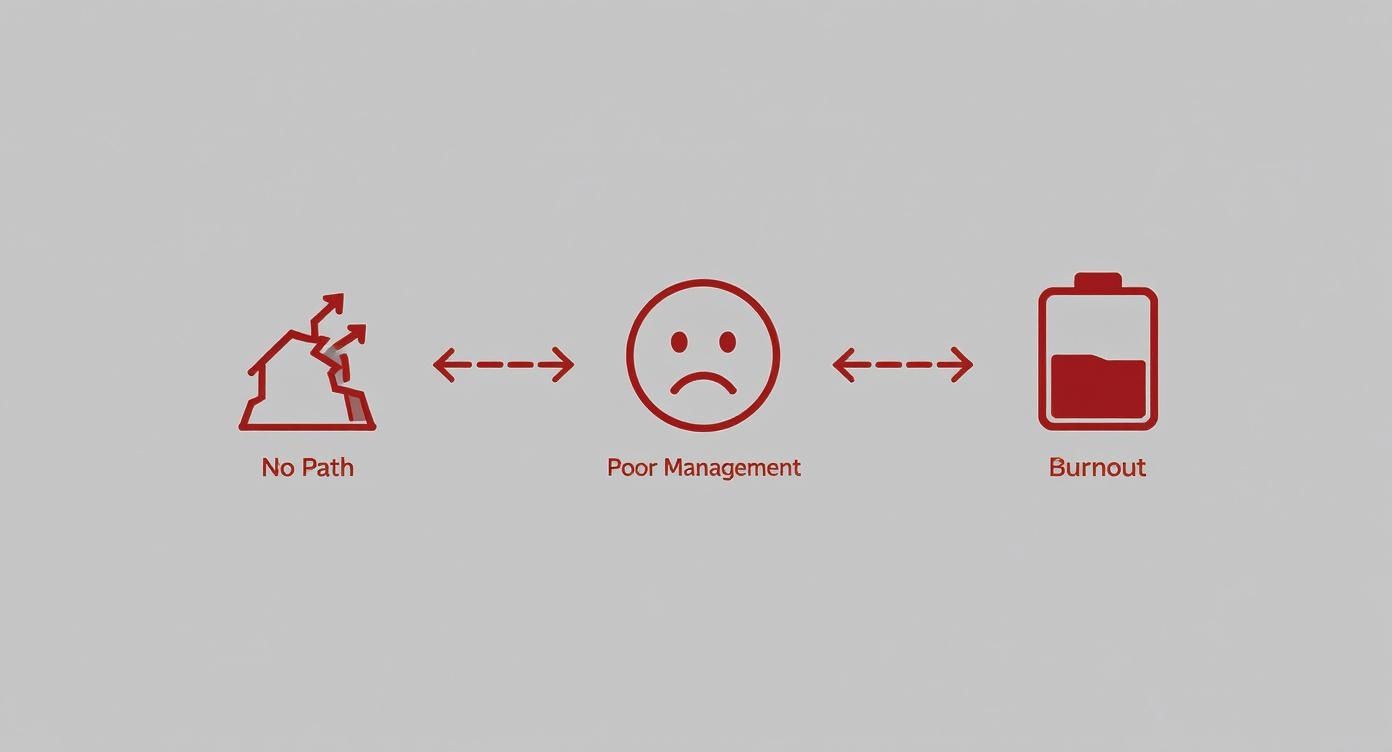
As you can see, it's a vicious cycle. A role that feels like a dead end causes frustration with managers, which fuels the burnout that makes leaving feel like the only way out.
✦Start With The Hard Data
Your investigation should always begin with the numbers. Quantitative data gives you an objective, bird's-eye view of your turnover patterns. It helps you find the hotspots in your organization so you can focus your energy where it’s needed most. Without it, you're flying blind.
Don't just glance at your overall company turnover rate and call it a day. You have to slice and dice the data to see what’s really going on. A healthy company-wide rate could be masking a full-blown crisis in a specific department or under a particular manager. Digging deeper is non-negotiable.
Below is a table summarizing the essential metrics you should be tracking to diagnose and monitor your employee retention. These numbers will help you move from speculation to a data-backed understanding of your turnover issues.
✦Key Retention Metrics You Should Be Tracking
| Metric | What It Measures | How to Calculate or Source It |
|---|---|---|
| Turnover Rate by Department | Which teams are losing people the fastest. | HRIS data; compare turnover rates across departments like Engineering, Sales, Marketing, etc. |
| Turnover Rate by Manager | The impact of individual managers on their team's stability. | HRIS data; group departing employees by their direct manager. A consistently high rate is a major red flag. |
| Voluntary vs. Involuntary Turnover | Why people are leaving—did they quit or were they let go? | Exit interview data and HR records. High voluntary turnover points to internal issues. |
| Turnover Rate by Tenure | When people are leaving in their employee lifecycle. | HRIS data; segment turnover by time-at-company (e.g., 0-6 months, 1-2 years, 5+ years). |
| Employee Net Promoter Score (eNPS) | Overall employee loyalty and satisfaction. | Pulse surveys. Ask: "On a scale of 0-10, how likely are you to recommend our company as a place to work?" |
| Promotion Rate | The frequency of internal promotions. | HRIS data. A low rate can signal a lack of career growth opportunities. |
Tracking these metrics consistently will give you the foundation you need to build a targeted and effective retention strategy.
The single most important metric to track before you do anything else is your company’s turnover rate. Without knowing how many people are leaving, when they’re leaving, and what part of the company they’re from, you can’t even begin to figure out why they’re leaving.
Once you have this data, you can start forming a real hypothesis. For example, "Our data shows the marketing department has a 40% higher turnover rate than any other team, especially for employees with 1-2 years of tenure. We suspect this is due to a lack of clear advancement opportunities."
✦Get The Full Story Through Conversation
Numbers tell you what's happening, but they can't tell you the story behind it. That’s where qualitative data comes in—the real thoughts, feelings, and experiences of your employees. This human element is what turns cold data points into truly actionable insights.
The best way to get this information is through simple, honest conversations. You have to create a safe environment where people feel they can share their real frustrations without any fear of it coming back to bite them. Your best tool for improving retention is proactive listening.
Here are a couple of powerful ways to gather that qualitative feedback:
- Simple Pulse Surveys: Don't wait for the annual survey. Use short, frequent pulse surveys to check in on the things that actually drive engagement, like workload, recognition, and manager support.
- Meaningful One-on-Ones: These meetings need to be more than just a project status update. Train your managers to use this time to ask real questions about career goals, challenges, and roadblocks. A well-run one-on-one can uncover a problem long before it turns into a resignation.
When you combine the "what" from your data with the "why" from your people, you'll finally have a clear picture of your retention challenges. This allows you to stop wasting resources on generic fixes and start developing targeted strategies that solve the real problems.
Invest in Career Paths, Not Just Perks
Let's be honest. Catered lunches and team happy hours are great, but they're band-aids. They create a quick burst of happiness, but they don't fix the underlying reasons why people start looking for a new job. If you're serious about keeping your best people for the long haul, you have to stop focusing on today's freebies and start showing them what their future looks like with you.
Ambitious people won't stay in a role that feels like a dead end. When they can't see a path forward, they’ll create their own—right out your door. A solid career development program isn't just a "nice-to-have"; it's your most powerful retention tool. It sends a clear message: we see you as a long-term investment, not a short-term asset.

✦Build Transparent Career Ladders
First things first: demystify career progression. Your employees should never have to guess what it takes to get promoted. When expectations are vague, people start to assume promotions are all about who you know, not what you do. That's a fast track to frustration and cynicism.
A career ladder (or framework) cuts through the noise. It clearly defines the roles, responsibilities, and skills needed for each level within a team. This transparency gives employees a map and empowers them to drive their own growth.
For this to actually work, you need to:
- Define Clear Competencies: Get specific about the skills and behaviors for each role. A junior software engineer might be expected to "write clean code," while a senior engineer should be able to "architect scalable systems."
- Show the Path Forward: Don’t just map out the current role. Show what the next level looks like, and the one after that. Let people visualize their future at the company.
- Make it Accessible: This isn't some secret HR document. Post your career ladders on the company intranet so they're available for everyone to see, anytime.
This simple act of creating a roadmap removes ambiguity and shows people you're committed to their journey.
Investing in career development isn’t just a feel-good initiative; it has a massive financial upside. When employees see a future, they are far more likely to stick around and contribute to the company's long-term success.
The numbers don't lie. A recent survey found that 93% of employees said they'd stay longer at a company that invests in their career. Better yet, companies that spend an average of $4,700 per employee on retention programs (including development) see 87% higher retention rates and an incredible 4.2x average return on investment. You can dig into more employee retention statistics to see the full picture.
✦Launch Mentorship Programs That Actually Work
A great mentor can completely change an employee's career path and their sense of belonging at work. The problem is, most mentorship programs are too informal and fizzle out. A good program needs structure, clear goals, and thoughtful pairing.
Don't just tell people to "go find a mentor." Create a real system. Try pairing junior employees with senior leaders who are outside their direct chain of command. This gives the mentee a safe space to ask tough questions and get honest advice without worrying about how it might affect their next performance review.
Regular check-ins are key, even just a monthly coffee or a quick video call. But for companies who rely on both Slack for communication and Google Calendar for scheduling, coordinating these recurring meetings can become a huge administrative burden. This is where a tool like Be There is incredibly handy. A manager can set up a recurring "Mentorship Meetup" event right inside a dedicated Slack channel. With one command, Be There automatically creates and sends a Google Calendar invite to all participants, keeping the program on track without any logistical headaches.
✦Train Managers for Future-Focused Conversations
Finally, you have to get your managers on board. Too many one-on-ones are purely tactical, focusing only on yesterday's metrics and today's to-do list. This is a huge missed opportunity.
Train your managers to shift their mindset from performance management to career development. Coach them to ask forward-looking questions, like:
- "What skills are you hoping to build in the next six months?"
- "Which parts of your job are giving you the most energy right now?"
- "If you were to design your ideal next role, what would it look like?"
These kinds of conversations prove to an employee that their manager is genuinely invested in their future. This small change can turn a manager from a simple taskmaster into a career coach—and that’s one of the most powerful retention levers you have.
Fostering a Culture of Recognition and Connection
Let's be honest: a good salary gets people through the door, but it's not what makes them stay for the long haul. The real secret to retention is building a culture where people feel genuinely seen, valued, and connected to their colleagues. Free snacks and ping-pong tables are nice, but they don't create the kind of deep loyalty that comes from feeling like you truly belong.
If you’re serious about keeping your best people, you have to move beyond the one-size-fits-all perks. It's about celebrating wins—both big and small—and creating real human connections that make work feel like more than just a list of tasks. When people feel tied to their team and the company's mission, their commitment skyrockets.

✦Go Beyond Generic Perks
Personalized engagement and recognition are incredibly powerful. Think about it: research shows 79% of employees are actively looking for companies that align with their personal values. When a company leans into this by tailoring its approach, it can achieve a 92% retention rate—way above the industry average.
This doesn't mean you need a massive budget or a complex system. It could be as simple as offering flexible hours for a parent juggling school pickups or giving a professional development stipend to someone hungry to learn a new skill. The key is to actually listen to what your team wants instead of just guessing.
✦Build Simple Recognition Rituals
Never underestimate the power of a simple "thank you." A staggering 66% of employees admit they would probably quit if they felt unappreciated. The good news? Meaningful recognition doesn’t have to be complicated or expensive.
Here are a few simple rituals I've seen work wonders:
- Peer-to-Peer Shoutouts: Kick off a dedicated Slack channel where anyone can publicly celebrate a colleague for their hard work. It creates a powerful cycle of positivity.
- "Wins of the Week": Set aside five minutes in your weekly team meeting for everyone to share one win, big or small. It’s a great way to build momentum and help people feel seen.
- Personalized Thank-Yous: Encourage managers to ditch the generic praise and instead send a specific, thoughtful message highlighting exactly how an employee made a difference on a project.
"People don’t just want to be paid more, they want to feel like valued members of the team. Make space in team meetings and company all-hands to champion individual successes, and ensure that team leaders are empowered to provide meaningful feedback."
If you’re looking for more inspiration, we have a complete guide with dozens of employee recognition program ideas you can start using today.
✦Foster Real Connections with Events People Actually Want
In a remote or hybrid world, creating genuine connections can feel tough, but it's never been more critical. The right kind of event can do wonders for team bonding, but the goal is to create experiences people are genuinely excited about—not another mandatory Zoom happy hour.
But for companies that run on Slack and Google Calendar, organizing these events can be a logistical nightmare. Juggling messy Slack threads, manually sending calendar invites, and chasing down RSVPs is a massive time-suck for whoever is stuck with planning.
This is exactly where a tool like Be There comes in. As an app built specifically for the Slack and Google Calendar ecosystem, it removes all the administrative headache. Imagine you want to plan a team-building trivia night. Instead of all that manual work, you just create the event directly in your team’s Slack channel. Be There instantly sends a Google Calendar invite to everyone in the channel and keeps track of RSVPs right there. It lets you focus on what actually matters: building a connected and engaged team. To make this all work, solid internal communication best practices are essential for keeping everyone aligned and engaged.
Event Planning for Hybrid Teams Doesn't Have to Be a Nightmare
We all know that a connected team is a team that sticks around. Those team lunches, virtual trivia nights, and happy hours are where the real bonds are formed. But for any company that uses both Slack and Google Calendar, the process of organizing an event can be a frustrating nightmare.
It’s a familiar, painful dance. You start a Slack thread to pick a time, which quickly gets buried. Then you have to hunt down everyone’s email to create a manual Google Calendar invite, paste the link back into Slack, and spend the next week chasing people down for an RSVP. It’s an administrative black hole.
This isn't just annoying; it's a culture killer. When planning events is a chore, they simply don't happen as often. For hybrid and remote teams who rely on tools like Slack and Google Calendar to stay connected, this friction is a huge problem. Fewer events mean weaker connections, and a fading sense of belonging is a one-way ticket to turnover.
✦The Chaos of "Simple" Event Planning
Let’s be honest, the administrative work involved in planning even a "simple" get-together is ridiculous. Think about the last time a manager tried to put a virtual happy hour on the books.
What should have taken five minutes probably looked more like this:
- The Endless Poll: First, a Slack poll goes out to find the "perfect" time, only to be ignored by half the team and immediately lost in the channel.
- The Manual Invite: Once a time is reluctantly agreed upon, the organizer has to manually create a calendar invite, hoping they didn't forget anyone from the channel list.
- The RSVP Scramble: People RSVP in three different places—a Slack DM, an email, and the calendar invite itself. The organizer is left trying to piece together a final headcount like a detective.
This clunky process does more than just waste an organizer's time. It actively discourages people from planning events in the first place and kills attendance for the ones that do get scheduled.
The real cost here isn't the wasted admin hours. It's the missed chances to build a strong, connected culture—the very thing that makes people want to stay.
A dedicated tool can completely change this dynamic by letting you create events right where your team already works.
By bringing event creation directly into Slack, you kill the need to constantly switch between apps and make the whole process feel effortless.
✦A Smarter Way to Bring People Together
This is exactly the headache a tool like Be There was designed to fix. It was built for teams that live in Slack and Google Calendar, turning that messy, manual process into something incredibly simple and automated. The goal is to get the admin work out of the way so you can focus on what actually matters: connecting with your colleagues.
Let’s replay that scenario with the HR manager. This time, they use Be There. They type a single command in the team's Slack channel, and a new event is created. Instantly, Be There sends a perfectly formatted Google Calendar invite to every single person in that channel. No fuss, no manual work.
Here’s what that looks like in practice:
- Create Events in Slack: No more jumping between tools. You create the event right where the conversation is happening.
- Automated Invites: Forget about collecting emails or checking channel lists. Be There automatically sends a Google Calendar invite to everyone in the channel.
- Synced RSVPs: When people accept the invite in their calendar, their status magically updates on the original Slack post. Everyone can see who’s coming with a quick glance.
This is a game-changer for anyone trying to build a better company culture. It makes planning events so easy that you'll find yourself doing them more often—more spontaneous coffee chats, more team lunches, more of the moments that build genuine connection. For more tips on making those gatherings great, check out our guide on hybrid meeting best practices.
By removing the friction, you empower your people to build the relationships that create real loyalty and a culture people don't want to leave.
Common Retention Questions Answered
Even with a solid plan, improving employee retention can feel like you’re trying to hit a moving target. As leaders, we often run into the same questions and roadblocks when trying to build a workplace people genuinely don't want to leave. Let’s cut through the noise and tackle some of the most common concerns with real, practical answers.
Getting this right isn't about one big, flashy initiative. It’s a constant cycle of listening, adapting, and truly investing in your people. Think of it as the small, consistent actions that show your team you see them as individuals, not just headcounts.
✦How Much Does Turnover Actually Cost?
Most leaders I talk to drastically underestimate the real financial hit of losing an employee. It goes way beyond just the cost of recruiting a replacement. Realistically, you're looking at a total cost of anywhere from 50% to 250% of that person's annual salary, depending on how specialized their role is.
That number seems high until you break down all the hidden costs:
- Recruitment Expenses: This includes everything from job board ads and recruiter fees to the countless hours your team spends screening and interviewing.
- Onboarding and Training: Think about the time and resources poured into getting a new hire ramped up.
- Lost Productivity: It can take a new person months to get to the same level of output as the person they replaced. During that gap, the team's overall productivity inevitably takes a dip.
- Team Morale: High turnover is a culture killer. It can leave the remaining team members feeling overworked, anxious, and disengaged, which often starts a domino effect.
The cost of turnover is always higher than you think. Investing in retention isn't a "nice-to-have" expense—it's a direct investment in your bottom line.
✦What Is the Single Biggest Driver of Retention?
While fair pay and clear career paths are definitely important, the one factor that consistently has the biggest impact is the quality of an employee's relationship with their direct manager. It sounds cliché, but the old saying "people leave managers, not companies" is a cliché for a reason. It’s true. A manager shapes an employee's day-to-day reality at work.
A great manager acts as a coach and an advocate. They give clear, constructive feedback and take a genuine interest in their people's growth. On the flip side, a poor manager—one who micromanages, fails to give recognition, or communicates poorly—can create a toxic environment that will drive away even your most committed employees.
✦How Do I Convince Leadership to Invest in Retention?
Getting buy-in from the C-suite almost always comes down to speaking their language: data and ROI. Instead of framing retention as a fuzzy cultural goal, you need to build a solid business case that connects your efforts to real financial outcomes.
Start with the turnover costs we just calculated. Show them exactly how much money is walking out the door every time someone quits. Then, pitch your initiatives—whether it's manager training or a new mentorship program—as the direct solution to stop that financial bleed. Frame it as a strategic investment with a clear, measurable return, not just another HR expense. For a deeper dive into what works, check out these proven strategies for improving staff retention.
✦Can You Fix a Retention Problem with Better Events?
Let's be clear: you can’t throw a pizza party to fix a toxic culture. But that doesn't mean events don't matter. They're a crucial piece of the puzzle. When done right, team events create the genuine human connections that make people feel like they belong to something more than just a company.
The problem is, their effectiveness completely depends on how they're executed. If planning an event is a logistical nightmare, it becomes a chore that people dread instead of a morale booster.
This is especially true for companies that rely on both Slack and Google Calendar, where the manual coordination is just painful. The endless back-and-forth, chasing down RSVPs, and manually creating calendar invites is a huge time-suck. It’s so frustrating that it often discourages people from planning anything at all.
This is exactly where a purpose-built tool changes the game. For teams living in both Slack and Google Calendar, a solution like Be There gets rid of all that friction. Someone can type a single command in Slack, and poof—an event is created and a Google Calendar invite is automatically sent to everyone in the channel. RSVPs are synced instantly. The whole process becomes effortless. This simplicity encourages more frequent, spontaneous get-togethers and lets your team focus on building culture, not drowning in logistics. By making connection easy, you reinforce the very foundation of what makes people want to stay.
Ready to stop the administrative headache and start building real team connection? With Be There, you can create and manage events directly in Slack, with automated Google Calendar invites and synced RSVPs. Start your free one-month trial today and see how easy it is to bring your team together. Discover Be There.
Share this post

Planning your internal events has never been easier!
No more scheduling headaches—our Slack-connected web app keeps things simple. Less email, more fun! 🚀
 Prefer a quick walkthrough?