
Be There
Blog

How to Improve Workplace Culture: Practical Steps for a Thriving Team
By BeThere
Dec 14, 2025 • 21 min read
Share this post


Improving workplace culture is all about being intentional. It means creating a place where people feel safe, genuinely connected, and truly recognized for their work. This isn't just about surface-level perks; it's about leaders actively showing the way and meeting the core needs of their teams.
Why Culture Is Your Most Powerful Business Tool
Let's get one thing straight: improving your company culture isn't about adding a ping-pong table in the breakroom. It’s a strategic investment that directly beefs up your bottom line. In a competitive market, a strong culture is what makes the difference between companies that thrive and those that just get by.
A great culture fuels productivity, sparks new ideas, and is your single best defense against your top talent walking out the door. It’s something you feel in the everyday interactions and the sense of belonging, not just in the benefits package.
For teams juggling Slack and Google Calendar in a hybrid setup, creating those connections can feel like an uphill battle. You’re constantly wrangling schedules and sending reminders for team events, which often creates more admin work than actual team bonding. This is exactly where a tool like Be There is incredibly handy. It’s built to cut through the logistical mess of organizing events right where your team already works, seamlessly connecting your Slack workspace with your team's Google Calendars to make connection feel easy and natural.
✦The Real Cost of a Disconnected Team
A positive culture isn't just a "nice-to-have"—it's a massive financial advantage. Think about this: employees who feel a strong bond with their company culture are 3.7 times more engaged at work. They're also 68% less likely to burn out.
This level of engagement has a direct impact on business results, with highly engaged teams seeing a 10% jump in customer ratings. Yet, global employee engagement actually dropped from 23% to 21% in 2024, costing the world economy a jaw-dropping $438 billion in lost productivity.
A great culture is your ultimate competitive advantage. It’s the invisible force that keeps your best people from looking for their next job and inspires them to deliver their best work.
✦Laying the Foundation for Change
This guide will walk you through a clear framework to build a workplace where people genuinely feel valued and motivated. We'll dig into actionable steps for three crucial pillars:
- Psychological Safety: How to create an environment where people feel safe enough to speak up, share ideas, and admit mistakes without fear of blame.
- Genuine Connection: How to build meaningful rituals and events that strengthen team bonds, especially when you're not all in the same office.
- Meaningful Recognition: How to design programs that make employees feel seen and appreciated in a way that truly motivates them.
To get a head start on the broader strategies, take a look at these 7 practical steps to improve workplace culture. By zeroing in on these core areas, you can start making real improvements that will be felt across your entire organization.
First, Find Out Where You Really Stand
You can’t improve your company culture if you don’t have an honest picture of what it looks like today. It's tempting to jump straight into new initiatives—more social events, a new recognition program—but without a proper diagnosis, you're just guessing. You often end up with well-intentioned efforts that completely miss the mark.
Before you change a thing, you need to get a real, unfiltered look at your cultural health. This isn't about placing blame; it's about pinpointing exactly where your opportunities are. The key is to combine a few different feedback methods to see the full picture.
✦Start with Anonymous Surveys
Anonymous surveys are your secret weapon for getting candid feedback, especially at scale. When people know their name isn't attached, they're far more willing to open up about the tough stuff. This gives you a powerful quantitative baseline to see where you stand.
But please, don't just ask generic satisfaction questions. To get meaningful data, you need to dig into the specific pillars of your culture.
- Communication: Do people feel like they’re in the loop on important decisions, or are they constantly left in the dark?
- Recognition: Does your team feel genuinely appreciated for their work, or does praise feel like a corporate box-ticking exercise?
- Psychological Safety: Are team members comfortable admitting they made a mistake or offering a different point of view without fearing backlash?
The answers will reveal broad trends and red flags, showing you exactly which areas need a closer look.
This is the fundamental choice every leader has to make. You either invest in understanding and improving your culture, or you accept the consequences.
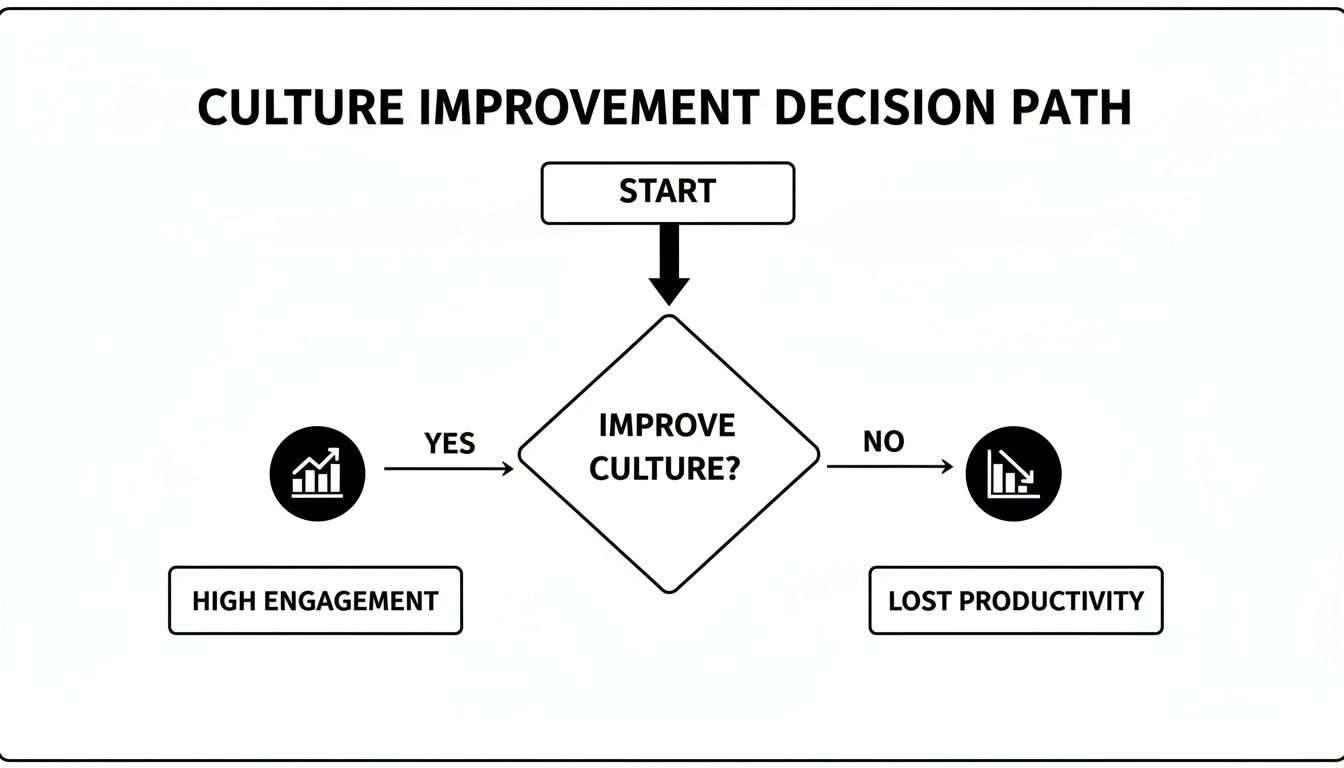
As you can see, the path of intentional cultural improvement leads straight to higher engagement and a healthier bottom line. The alternative? Lost productivity and a revolving door of talent.
✦Go Deeper with 'Stay' Interviews
Surveys tell you what is happening. One-on-one conversations tell you why.
Instead of waiting for exit interviews to find out what went wrong, get proactive with "stay" interviews. Sit down with your key employees—the people you absolutely can't afford to lose—and find out what keeps them showing up every day.
The goal here is proactive engagement, not reactive damage control. Asking simple questions like, "What's one thing you look forward to at work?" or "If you had a magic wand, what's one thing you'd change about our team?" can uncover incredibly valuable truths about what’s working and what’s not.
✦Use Focus Groups for Targeted Insights
Once your surveys and interviews have highlighted specific themes—maybe a lack of collaboration between departments or wildly inconsistent management styles—it’s time for focus groups.
These small, guided discussions are perfect for exploring those nuanced topics in more detail. They allow employees to build on each other's ideas, giving you rich, qualitative context that numbers on a spreadsheet will never provide.
For example, if survey data shows low scores on "feeling valued," a focus group can tell you what meaningful recognition actually looks like. You might discover that the engineering team craves public praise for a project well done, while the sales team would much prefer professional development opportunities as a reward.
✦Choosing the Right Culture Feedback Method
Gathering feedback isn't a one-size-fits-all process. Each method has its own strengths and weaknesses. The trick is to use a mix of approaches to get a balanced, 360-degree view of your culture.
| Method | Best For | Pros | Cons |
|---|---|---|---|
| Anonymous Surveys | Getting a broad, quantitative baseline of cultural health from the entire organization. | High honesty rate due to anonymity; easy to scale and analyze for trends. | Lacks context and nuance; can't ask follow-up questions to dig deeper. |
| 'Stay' Interviews | Understanding what motivates your top performers and identifying potential retention risks. | Builds trust; provides deep, qualitative insights; highly proactive. | Time-consuming to conduct at scale; success depends on manager's skill. |
| Focus Groups | Exploring specific, complex issues identified by surveys or interviews in a collaborative setting. | Rich, interactive discussions that uncover shared perspectives and nuanced opinions. | Can be influenced by group dynamics; some may not feel comfortable sharing openly. |
By using a blend of these methods, you get the best of both worlds: hard data to identify trends and rich stories to understand the human experience behind them.
Combining these different feedback channels moves you from simply guessing what’s wrong to knowing where your pain points are. This diagnosis is the essential first step before you can implement practical strategies to improve company culture that actually work. With a clear map in hand, you’re ready to build solutions that solve the real problems, not just the surface-level symptoms.
Creating an Environment of Psychological Safety
Psychological safety is the secret sauce of any high-performing team. It's that unspoken understanding that you can toss out a half-baked idea, ask a tough question, or even admit you messed up without fear of being shamed or punished. When your team has that foundation of trust, you see creativity and collaboration really take off.
Without it? You get a culture of silence. People hold back, worried they’ll be shut down or look foolish. This isn't just some "soft skill"—it’s a non-negotiable for the agility your business needs to survive. A culture of fear is one of the quickest ways to kill productivity and send your best people packing.

✦Model Vulnerability From The Top
If you want to build psychological safety, it has to start with leadership. There’s no more powerful way.
When a manager openly says, "You know what, I was wrong about that approach," or "I don't have the answer here, what are you all thinking?" it sends a powerful message. It tells the team it’s okay not to be perfect and that their input is actually wanted. This isn't a sign of weakness; it's a show of confidence in your team.
Psychological safety isn't about being nice. It's about giving candid feedback, openly admitting mistakes, and learning from each other in order to achieve excellence and solve complex problems.
The data tells the same story. PwC's 2025 Global Workforce Hopes and Fears Survey found a direct link between safety and performance. Employees with the highest psychological safety are a staggering 72% more motivated than those who feel the least safe.
Despite this, only 56% of workers feel comfortable trying something new, and just 54% see failures as a chance to learn. That's a huge gap many companies need to close.
✦Reframe How You Respond To Failure
How a leader reacts when a deadline is missed or an experiment bombs can either build a resilient team or a fearful one. Think about it: a project goes sideways. A manager who immediately demands, "Whose fault is this?" is essentially training their team to hide mistakes and point fingers.
A much better way is to ask forward-looking questions:
- What did we learn from this? (This shifts the focus from blame to growth.)
- What can we do differently next time? (This prompts a problem-solving mindset.)
- How can I better support you moving forward? (This shows you’re a coach, not a judge.)
When you treat failure as a necessary part of innovation, you give your team permission to take smart risks. That's where breakthroughs come from. Building this kind of rapport takes effort, and you can get more practical tips in our guide on how to build trust in teams.
✦Establish Clear Rules For Respectful Debate
Conflict isn't the problem; disrespectful conflict is. You need healthy debate to stress-test ideas and find the best path forward. The trick is to set clear ground rules for how your team navigates these conversations.
A few simple guidelines can completely change the dynamic. For example, encourage everyone to "challenge the idea, not the person." Promote active listening by having people summarize the last point before they make their own. When people feel secure that the conversation won't turn personal, they’re much more willing to share those bold, unconventional ideas that could become your next big win.
Using Rituals to Strengthen Team Connection
When your team is hybrid or fully remote, real connection doesn't just magically happen in meetings. It has to be built, piece by piece, through small, consistent habits that become the heartbeat of your team. I'm not talking about forced fun or those awkward virtual happy hours. I'm talking about meaningful rituals that actually strengthen bonds and improve your culture.
These rituals can be surprisingly simple. A 'Weekly Wins' channel in Slack where people share a success—personal or professional, big or small—is a great start. Or you could try structured virtual coffee chats, pairing random colleagues for a 15-minute, non-work catch-up. These little moments create the connective tissue that holds a team together, especially when you're not bumping into each other at the water cooler.

✦From Good Idea to Ghost Town
Here's the problem I’ve seen time and again: coming up with ideas for culture-building isn't the hard part. It's the execution.
A brilliant idea can easily get crushed under the weight of administrative friction. Someone has to schedule it, send the calendar invites, post the reminders, and chase down RSVPs. This busywork often lands on one person’s plate, turning a great initiative into a logistical nightmare.
This is especially true for companies that run on Slack and Google Calendar. You can announce an awesome 'Demo Day' for teams to share their work, but getting it on everyone’s calendar and making sure they show up involves a ton of back-and-forth. The good intention is there, but the follow-through gets lost in the daily grind.
The secret to successful team rituals is making them completely frictionless. If organizing an event feels like a chore, it won’t happen consistently, and you’ll never see the cultural benefits.
This is exactly the gap that tools like Be There were built to fill. For companies using both Slack and Google Calendar, it is exceptionally useful. It acts as the perfect bridge between your communication hub and your scheduling tool, killing the manual coordination that stops great ideas from taking root.
That simple shift from manual work to automated ease is a game-changer for anyone trying to build a real community.
✦Making Connection Effortless
Let’s say you want to kick off a monthly 'Ask Me Anything' (AMA) with leadership. For a team reliant on Slack and Google Calendar, a tool like Be There makes this incredibly handy.
- Create the Event in Slack: Just draft the AMA details right in Slack, where your team already is.
- Sync with Google Calendar: With a single click, team members can RSVP, and the event instantly appears on their Google Calendar. No more "Hey, can you send me an invite?" DMs or manual calendar entry.
- Automated Reminders: The tool sends a nudge in Slack right before the AMA starts, boosting participation without you having to lift a finger.
This simple workflow means anyone can be a culture champion. A team lead can organize a project kickoff, or an HR manager can set up a recurring "Wellness Wednesday" without getting bogged down in administrative hell.
✦What Kinds of Rituals Can You Run?
Once you remove the logistical headaches, you can get creative and build a whole range of rituals that cater to different needs and strengthen connections across the company.
Here are a few ideas to get you started:
- Knowledge-Sharing Rituals: Think "Lunch & Learns" where someone teaches a new skill, or "Demo Days" for engineering teams to show off what they’ve built. These are fantastic for building cross-functional respect.
- Social Connection Rituals: Go beyond the standard happy hour. Try a virtual book club, a gaming session, or structured "Donut" style coffee chats. These low-pressure events help people connect as humans, not just as colleagues.
- Recognition and Celebration Rituals: Host a quick monthly awards ceremony to celebrate team wins or create a special welcome event for new hires. Making these moments feel organized and special shows your team they're valued.
By automating the tedious parts of event planning, you free up everyone’s time and energy to focus on what actually matters: creating consistent, meaningful moments that build a stronger, more connected culture. It’s how a good idea becomes a beloved company tradition.
Designing Recognition That Truly Motivates
Let’s be honest: most employee recognition programs are a bit of a letdown. They often feel generic, happen way too late, and seem disconnected from the hard work people are actually doing day-to-day. If you want to build a culture where people feel genuinely valued, you have to do better than the annual bonus or a gift card that shows up three months after a project wraps.
What really moves the needle isn't always money. It’s the timing, the specifics, and the sincerity. A quick, public shout-out from a manager right after a big win can mean more than any formal award. It proves you’re paying attention. It shows you get it.

✦Beyond Cash: The Total Rewards Approach
A modern take on recognition looks at the whole person. We're talking about a "Total Rewards" model that goes beyond a paycheck to address what employees really need to feel secure and supported—things like financial stability, solid healthcare, flexibility, and, of course, meaningful appreciation.
This isn't just a feel-good idea. The 2025 Global Culture Report introduction from O.C. Tanner points out that employees can't thrive if their basic needs aren't met. With global engagement numbers staying flat, it’s clear that building a resilient culture starts with this foundation.
After all, you can't praise someone into being engaged if they're worried about their finances or on the brink of burnout. The system has to work together.
✦Weaving Recognition into Daily Rituals
The best way to make recognition stick is to build it right into your team's regular routines. This turns appreciation from a clunky, top-down mandate into a natural habit shared by everyone. Plus, it ensures great work gets celebrated in the moment, not forgotten six months later during a formal review.
This is another place where getting your event management sorted can be a game-changer, especially for teams living in Slack and Google Calendar.
Imagine you want to start a monthly "Spotlight Ceremony" to celebrate big wins. Instead of a logistical nightmare of invites and reminders, a tool like Be There is very useful here. You can schedule it once, automate the reminders in Slack, and get it on everyone's Google Calendar without the hassle. It makes celebrating your team a seamless and fun ritual people actually look forward to.
Recognition is a powerful form of communication. Every time you praise someone, you're not just making them feel good—you're showing the entire team what success looks like and what your company truly values.
✦Making Peer-to-Peer Recognition Stick
While a manager's praise is important, some of the most powerful kudos come from the person in the trenches with you. When a coworker takes a second to acknowledge your contribution, it just hits different. It builds real camaraderie.
But peer-to-peer programs often fizzle out because they're too complicated or feel forced. The secret is to make it ridiculously easy for people to give each other a shout-out.
- Fire up a dedicated Slack channel. Something simple like
#winsor#shoutoutscreates a public space for anyone to post praise. - Lead by example. Managers and leaders need to jump in first and use the channel regularly. This shows everyone how it's done and gives them permission to join in.
- Use simple prompts. In team meetings, just ask, "Who deserves a shoutout for helping you out this week?"
By making it dead simple for people to recognize one another, you embed appreciation into how your team works every single day. These small, consistent acts add up, creating a culture where everyone feels seen. For more ways to flesh out your strategy, our guide on employee recognition program ideas is packed with practical tips.
How to Measure and Sustain a Thriving Culture
Improving your company culture isn't a project you can just check off a list. It’s an ongoing process—a continuous cycle of listening, adapting, and encouraging the behaviors you want to become the norm. After putting in the hard work to build connection and psychological safety, the next step is to make sure those positive changes actually stick.
To do that, you need to look beyond gut feelings and dig into the data. The right metrics will tell you what’s working, what isn’t, and where to focus your energy next. This data is also your best friend when it comes to showing leadership the real, tangible ROI of your culture initiatives.
✦Key Metrics for Tracking Cultural Health
You can start by tracking a few key numbers that give you a clear, honest look at your cultural health. Think of them as the vital signs of your organization.
- Employee Net Promoter Score (eNPS): This is your quick pulse check. It’s based on one powerful question: "On a scale of 0-10, how likely are you to recommend our company as a great place to work?"
- Voluntary Turnover Rate: An oldie but a goodie. When your best people are choosing to stay, it’s one of the strongest indicators of a healthy, supportive culture. High turnover is a flashing red light.
- Pulse Survey Trends: Short, frequent surveys on specific topics—like communication, recognition, or well-being—are fantastic. They show you how your new initiatives are actually being received by the team in near real-time.
A thriving culture shows up in both your dashboards and your day-to-day interactions. You need to pay attention to both the numbers and the human experience to see the full picture.
✦Weaving Culture into Your Company's DNA
Data tells you what is happening, but making it last means weaving your culture into the very fabric of how your company operates. This is how you make your desired culture the default setting, not a "nice-to-have" initiative.
A great place to start is by embedding your cultural values into key moments in the employee journey. During onboarding, new hires shouldn't just learn about their job; they should be immersed in your company's way of working from day one. In performance reviews, shift the conversation to include how people achieve their results, not just what they achieve.
Want to go deeper on this? We've put together a complete guide on how to measure company culture that's packed with practical advice.
Ultimately, nothing reinforces culture more powerfully than leadership behavior. When leaders consistently model the company values, recognize others for doing the same, and communicate with transparency, they make the culture real for everyone. That top-down commitment is what creates a sustainable system where a positive culture doesn't just survive—it flourishes.
Your Questions About Improving Workplace Culture, Answered
When you decide to get serious about improving your workplace culture, a lot of questions pop up. I’ve heard these same ones from leaders time and time again, so let’s tackle them head-on.
✦How Long Until We See Real Change?
You’ll likely notice small morale boosts within a few weeks, which is great for building momentum. But let’s be real: deep, lasting cultural change is a long game.
Expect it to take anywhere from 6 to 18 months of consistent, dedicated effort. You're not just implementing a new policy; you're fundamentally changing ingrained habits and building trust. Think of it as a marathon, not a sprint, and remember that it all starts with unwavering commitment from leadership.
✦What’s the Single Most Important Thing for a Successful Culture Shift?
It’s leadership behavior. Period.
Leaders are the culture setters. If they aren’t visibly living the values you’re trying to build—practicing open communication, showing vulnerability, giving genuine recognition—none of the other initiatives will stick. The best-laid plans fall flat if the people at the top aren't modeling the way.
A great culture doesn't just happen. It's the direct result of leaders consistently demonstrating the values they want to see in their teams.
✦Is This Possible on a Tight Budget?
Absolutely. In fact, many of the most impactful culture-building activities are free.
Creating psychological safety where people feel safe to speak up, offering public praise for a job well done, or starting simple team rituals—these things cost time and intention, not a line item in your budget. The most critical investment isn't financial; it's the genuine commitment from your leadership team.
For teams that practically live in Slack and use Google Calendar, the main "cost" of these rituals can feel like the time and hassle of organizing them. That's where a smart tool is incredibly handy. An event planner like Be There, for example, gets rid of all the annoying admin work. It automates scheduling, invites, and reminders right where your team already works, so building those crucial connections is easy and doesn't add to anyone's plate.
Ready to make team events effortless and fun? Be There is the first event planner built for Slack, helping you create, manage, and celebrate company culture without the administrative headache. Start your free trial at https://be-there.co.
Share this post

Planning your internal events has never been easier!
No more scheduling headaches—our Slack-connected web app keeps things simple. Less email, more fun! 🚀
 Prefer a quick walkthrough?