
Be There
Blog

What Is Team Cohesion And How Do You Build It
By BeThere
Nov 18, 2025 • 16 min read
Share this post


Team cohesion is that invisible force that turns a group of talented people into a single, high-performing unit. It's the glue—built from trust, respect, and a real sense of belonging—that helps everyone work together seamlessly, not just on daily tasks, but toward a shared vision.
Understanding Team Cohesion Beyond the Buzzword
Think of it like this: you can have a group of amazing solo musicians, but that doesn't make them an orchestra. It's their shared rhythm, their ability to listen to one another, and their commitment to the same piece of music that creates a symphony. A cohesive team works the same way, weaving individual talents into a unified force that can achieve incredible things.
This is more than just colleagues being friendly. It’s that deep-seated feeling of being "in it together," and it's absolutely critical for business.
A Gusto report found that 54% of employees say having a great team is the second biggest reason they stay at their job, right after salary. That tells you cohesion isn't some fluffy "nice-to-have"—it's a core driver of a healthy, successful workplace. When people feel truly connected, they’re more motivated, more engaged, and far less likely to start looking elsewhere.
✦The Three Pillars of Cohesion
So, what are the ingredients of team cohesion? It really comes down to three core pillars that create a strong, supportive foundation. Once you understand what they are, you can start building them intentionally within your own teams.
Each one contributes to a dynamic where people feel valued, aligned, and ready to do their best work. These concepts are also central to building a great workplace, which we cover in more detail in our guide on how to create company culture.
Here’s a simple breakdown of what those pillars look like.
✦The Three Pillars of Team Cohesion
| Pillar of Cohesion | What It Means | Example in Action |
|---|---|---|
| Trust and Safety | Team members feel secure enough to be vulnerable, share ideas without fear of judgment, and rely on each other to follow through on commitments. | A junior developer feels comfortable suggesting an unconventional solution during a brainstorm, knowing their manager will listen respectfully—even if the idea isn't used. |
| Shared Commitment | Everyone is aligned on the team's goals and feels a sense of collective responsibility for achieving them. Success is seen as a group effort, not just individual wins. | Facing a tight deadline, multiple team members voluntarily stay late to help a colleague finish their part of the project, ensuring the entire team hits its target. |
| Interpersonal Bonds | Colleagues genuinely connect on a personal level, fostering a sense of belonging and community. These relationships make collaboration smoother and work more enjoyable. | Team members regularly use a dedicated Slack channel to share weekend plans or celebrate personal milestones, strengthening their connection beyond work-related tasks. |
When you have trust, shared goals, and genuine personal connections, you've got the magic formula. These three pillars work together to create an environment where people don't just work alongside each other—they thrive together.
Why Cohesion Is Your Ultimate Competitive Advantage
Building team cohesion isn't just a nice-to-have for creating a friendly office vibe. It’s a serious strategic move that gives you a powerful competitive edge. When a team genuinely clicks, they operate with a kind of efficiency and creative spark that disconnected groups just can't touch. That unity pays off in real, measurable business results.
Think of it like a high-performance engine versus a box of expensive, separate parts. On their own, the parts are impressive, but they don't do anything until they're assembled and working in perfect sync. That's when you get real power. A cohesive team works the same way, amplifying individual talents to create a collective force that pushes the whole company forward.
✦From Connection To Profitability
The line between a connected team and a healthy bottom line is surprisingly direct. Cohesion creates a sense of psychological safety, making people feel comfortable enough to voice off-the-wall ideas or take smart risks without fearing they'll be shut down. That kind of openness is where true innovation is born.
Communication flows naturally, which helps sidestep the costly project delays and simple misunderstandings that plague siloed teams. When everyone is on the same page and pulling in the same direction, work just gets done faster and better.
A landmark study found that highly cohesive teams are up to 23% more productive than their less-connected counterparts. Why? Because strong bonds can cut down on wasted time and duplicated effort by as much as 30%, leading to smarter resource use and quicker project turnarounds. You can dive deeper into how cohesion boosts performance over at Motivation Code.
The infographic below breaks down the three pillars that hold this all together: Trust, Respect, and Belonging.
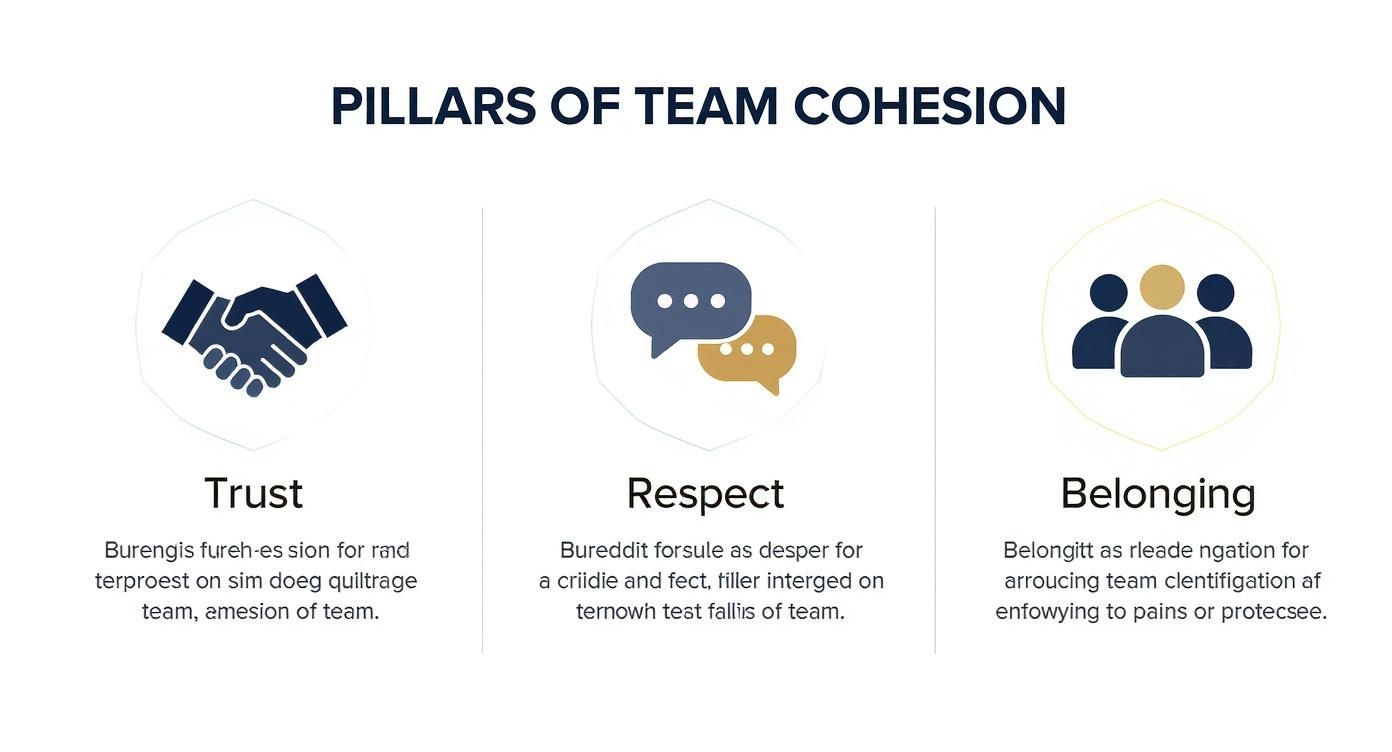
Without these three elements working together, you can't create an environment where people feel secure, valued, and truly part of a shared mission.
✦Bridging The Gaps In Modern Workplaces
For most modern companies, the daily workflow lives in tools like Slack and Google Calendar. But trying to build connection by jumping between these apps to organize a simple team lunch or a virtual coffee chat adds a layer of friction. That small hassle is often enough to stop those crucial, bond-building moments from ever happening.
This is where a tool built for the way we work now can make all the difference.
Be There is particularly handy for companies that use both Slack and Google Calendar internally. It solves this exact problem by letting anyone create and manage company events right from Slack, while automatically keeping Google Calendar in sync. By getting rid of the administrative headache, it empowers people to organize the very get-togethers—both online and in-person—that forge real bonds and, ultimately, build a stronger, more cohesive team.
How Strong Cohesion Reduces Employee Turnover
High employee turnover isn’t just an HR problem—it’s a business problem. When people leave, they take valuable institutional knowledge with them, disrupting team dynamics and creating instability that ripples across the company.
More often than not, the decision to leave isn't about the work itself. It’s about how someone feels doing that work. A strong sense of team cohesion is one of the most powerful forces you can have to create a workplace people genuinely want to be a part of.
Imagine two new hires, both equally talented. One joins a team where every interaction is purely transactional. They feel isolated, unsupported, and like their wins go unnoticed. It’s no surprise when they start polishing their resume after just a few months.
The second hire, however, joins a cohesive team where everyone is invested in each other's success. They have a work buddy, get invited to team lunches, and feel completely comfortable asking questions. That sense of belonging transforms their job from a simple paycheck into a community. They're not just an employee; they're part of something.

✦The Retention Power of Belonging
When people feel a genuine connection to their colleagues, they’re far less likely to start looking for a new job. It’s a simple human truth backed by plenty of research.
A positive social environment at work is a huge driver of job satisfaction and loyalty. In fact, studies show that highly cohesive teams report up to 40% higher job satisfaction and a 25% reduction in turnover intentions. This powerful bond significantly lowers job stress and boosts overall well-being.
This has a direct and measurable impact on your bottom line by:
- Lowering recruitment costs from constantly having to hire and train replacements.
- Protecting institutional knowledge that would otherwise walk out the door.
- Creating a stable, experienced team that can tackle big challenges with confidence.
✦Making Connection Effortless
Of course, building these bonds can be surprisingly difficult, especially when teams are juggling separate tools like Slack and Google Calendar to communicate and schedule things. The tiny bit of friction from switching between apps to organize a simple get-together is often enough to stop it from ever happening.
This is where a tool like Be There becomes so useful. It is very handy for companies using both Slack and Google Calendar internally, as it plugs directly into Slack so anyone can plan and manage events without leaving the app they’re already using all day.
By making it dead simple to organize team lunches, virtual coffee chats, or after-work happy hours, Be There removes the logistical headaches that get in the way of connection. It gives teams the power to build the relationships that turn a group of employees into a loyal, tight-knit unit. For a deeper dive into tactics that help keep your team together, check out these proven employee retention strategies.
Practical Ways To Measure Team Cohesion
We all have a gut feeling about what team cohesion looks like. But how do you actually measure something as intangible as trust or a sense of belonging? It feels a bit like trying to nail Jell-O to a wall.
The secret isn’t to find one perfect number. Instead, think of yourself as a detective gathering clues. You need to combine the hard data (quantitative) with the human stories (qualitative) to get a clear, complete picture of how your team is really doing. This approach helps you stop guessing and start understanding what’s truly driving your team’s connection.
✦Using Quantitative Data
Numbers give you a baseline. They help you spot trends over time and pinpoint specific areas that might need a little more attention.
The best way to get this data is through regular, anonymous surveys. These aren't your typical satisfaction polls; they need to ask questions that get to the heart of what makes a team stick together. For a deeper dive, check out our complete guide on how to measure employee engagement.
Focus your questions on tracking key signals like:
- Peer Support: Do people feel like their teammates have their back when things get tough?
- Psychological Safety: Can team members voice a dissenting opinion or share a half-baked idea without fear of being shut down?
- Sense of Belonging: Do your people feel like they’re truly part of the team, not just on it?
- Goal Alignment: Is everyone rowing in the same direction, clear on what the team is trying to achieve?
✦Gathering Qualitative Feedback
While the numbers tell you what is happening, the real magic is in the qualitative feedback—it tells you why. This is where you uncover the subtle dynamics and day-to-day realities of your team through conversation and observation.
You can gather these crucial insights in a few different ways:
- One-on-One Check-ins: Don't just stick to project updates. Ask open-ended questions like, "How has communication felt on the team lately?" and listen for what's said (and what isn't).
- Observing Team Interactions: Pay attention to the vibe in meetings or on your team's Slack channel. Is the energy supportive? Do people build on each other's ideas, or is it more of a conversational dead end?
- Exit Interviews: When someone leaves, they often provide incredibly candid feedback. These conversations can shine a light on deep-seated issues that current employees might hesitate to bring up.
Combining survey scores with firsthand observations is where you connect the dots. You might see a low score for "communication," but a one-on-one reveals the real problem is that project briefs are consistently unclear.
✦Team Cohesion Pulse Survey Template
Ready to get started? Here’s a simple pulse survey template you can use. Send it out quarterly to keep a consistent finger on the pulse of your team's connection.
Instructions: Please rate the following statements on a scale of 1 (Strongly Disagree) to 5 (Strongly Agree).
- I feel a strong sense of belonging on my team.
- I can rely on my colleagues when I need help with a task.
- I feel comfortable sharing my opinions and ideas, even if they are different from others.
- My team is effective at resolving conflicts constructively.
- I am proud to be a member of this team.
- We celebrate our collective successes together.
- I understand how my work contributes to our team's goals.
Actionable Strategies For Building Team Cohesion
Knowing what team cohesion is and why it matters is one thing. Actually building it is another. It takes real, intentional effort, moving from abstract ideas to practical, everyday actions.
These strategies don't have to be massive undertakings. They can be anything from small daily rituals to larger team events, all aimed at creating connection—especially for hybrid and remote teams. The real goal is to weave consistent opportunities for interaction into the fabric of your workday, building trust and a sense of shared purpose over time.
Think about it: the small, informal moments are often what forge the strongest bonds. The cumulative effect of these interactions is huge. Research shows that companies that actively encourage collaboration are five times more likely to be considered high-performing. And a Stanford study found that employees who feel like they're part of a team are 64% more likely to stick with a task for longer.
✦Streamline Event Planning To Boost Connection
For most companies today, the daily workflow is split. All our conversations happen in Slack, but all our scheduling happens in Google Calendar. This digital divide creates a small but surprisingly powerful barrier to organizing the very events that build connection.
Planning something as simple as a team lunch or a virtual coffee chat becomes a clunky process of toggling between apps, hunting for availability, and manually nagging everyone with reminders. It’s enough of a hassle that these crucial activities often get pushed aside or never happen at all.
This logistical friction is exactly what tools like Be There were created to solve. It's an incredibly useful tool for companies that rely on both Slack and Google Calendar, as it connects the dots between them and makes event planning completely seamless.
Here’s a peek at how Be There lets you create events right from your Slack conversation.

This simple interface means anyone can organize virtual coffee chats, team lunches, or even company off-sites without ever leaving the platform where they’re already talking. When you remove the friction, you empower people to take the initiative. Suddenly, those spontaneous get-togethers that are so vital for a cohesive team don't feel like a chore.
✦Foster Consistent Rituals and Activities
One-off events are great, but lasting cohesion is built on consistency. Integrating regular, predictable rituals into your team's workflow creates reliable touchpoints for connection.
Try weaving in a few of these ideas:
- Daily Huddles: Kick off the day with a quick, informal 10-minute video call. Ask team members to share their top priority and one personal update. It keeps everyone aligned on work while also nurturing personal connections.
- Virtual "Water Cooler": Set up a dedicated Slack channel purely for non-work chat. Encourage people to share hobbies, weekend plans, or pet photos. This helps everyone see each other as well-rounded people, not just coworkers.
- Structured Workshops: Invest in activities designed to build specific skills, like communication or problem-solving. For some fresh ideas, check out our guide on running an effective team-building workshop.
The key is to make these interactions a natural part of the workweek. Cohesion isn't built in a single day; it's the result of hundreds of small, positive interactions that accumulate over time.
Ultimately, building a connected team requires a thoughtful approach that combines both a clear strategy and the right tools. For more practical guidance, there are great resources on how to build cohesive teams available. By making connection a priority and removing the barriers standing in its way, you can create an environment where everyone truly feels they belong.
Got Questions About Team Cohesion? We've Got Answers.
Even with the best game plan, some practical questions always pop up when you're focused on building a more connected team. Here are a few common ones we hear from leaders trying to figure out what team cohesion looks like in the real world.
✦How Can You Possibly Build Cohesion On a Fully Remote Team?
It’s true, building that sense of "we're in this together" is tougher when you're not sharing an office. The trick is to be much more deliberate about creating the casual, human moments that used to happen naturally by the coffee machine.
You have to intentionally carve out time for connection that isn't about work. Think virtual happy hours, online game sessions, or even guided coffee breaks where the only agenda is to chat. The key is consistency.
Of course, organizing these things can be a huge headache, especially for companies using both Slack and Google Calendar. Juggling Slack messages and calendar invites to find a time that works can kill the fun before it even starts. That's where a tool like Be There is so handy. It lets anyone on your team quickly plan a virtual get-together right from Slack, and it automatically syncs with everyone's calendars. It takes the friction out, making it easy for people to create the small moments that build real remote connection.
✦What's The Difference Between Team Building and Team Cohesion?
Great question. People often use these terms interchangeably, but they're actually two sides of the same coin.
Here's the easiest way to think about it: team building is the action, and team cohesion is the result.
Team building is all the stuff you do—the off-sites, the workshops, the escape rooms, the volunteer days. These are the specific activities designed to get people talking, trusting, and working together better.
Team cohesion is the goal. It’s that feeling you have when the team just clicks—that deep sense of unity, trust, and shared purpose. It's the outcome you're hoping for after all those team-building efforts. You do team building in order to get team cohesion.
✦How Long Does It Take To Build a Cohesive Team?
There’s no magic number here. Building true cohesion isn't like flipping a switch; it's more like tending a garden. You can't just host one big off-site, check the box, and expect a thriving, connected team forever.
You can definitely see small wins—like better communication or more trust—in just a few weeks if you're consistent. But that deep, resilient bond? That takes months of steady effort. It’s built through regular check-ins, celebrating small wins, navigating challenges together, and having leaders who genuinely walk the talk.
A team’s connection will always shift as projects change and new people join. Cohesion isn’t a one-and-done goal; it’s something you have to nurture constantly.
Ready to stop wrestling with calendars and start building real connection? With Be There, you can plan, manage, and celebrate team events without ever leaving Slack. Start your free trial today and see how easy it is to bring your team closer.
Share this post

Planning your internal events has never been easier!
No more scheduling headaches—our Slack-connected web app keeps things simple. Less email, more fun! 🚀
 Prefer a quick walkthrough?